If you look at Weston home prices and wonder why two large properties can trade at very different numbers, you are asking the right question. Weston’s luxury market is not just expensive. It is selective, thin, and highly sensitive to details that matter more here than they might in a broader suburban market. If you are buying or selling in Weston, understanding those details can help you price more accurately, negotiate more confidently, and avoid costly assumptions. Let’s dive in.
Weston luxury starts with scarcity
Weston is a limited-inventory market with high price points and a relatively small number of homes available at any given time. Public market data points to roughly 46 to 50 active listings, with median list prices in the low to mid $3 million range, median sold prices around the low to mid $2 million range, and median days on market generally around 25 to 31 days.
Different platforms frame the market a little differently. Redfin describes Weston as very competitive, while Realtor.com has described it as balanced. That gap is useful because it shows Weston is not a one-speed market. In the luxury tier, pricing often moves based on property-specific factors rather than broad market averages alone.
Redfin’s luxury data adds another layer. It shows 54 luxury homes for sale with a median listing price of about $3.32 million, and it notes that luxury homes typically stay on the market for 49 days and receive 9 offers. The numbers vary by platform and methodology, but the bigger takeaway is clear: Weston is a scarce, price-sensitive luxury market where quality differences can have an outsized effect.
Land drives value in Weston
Large-lot zoning shapes the market
One of the biggest reasons Weston behaves differently is zoning. The town’s single-family zoning requires large lots, with minimum lot areas ranging from 20,000 square feet in District D to 60,000 square feet in District A. Frontage requirements range from 150 to 250 feet, along with meaningful setbacks.
That matters because land in Weston is not just a backdrop. It is part of the product. Since large lots are already built into the town’s rules, the market tends to reward usable land, privacy, and site quality more than raw acreage by itself.
Privacy is part of the appeal
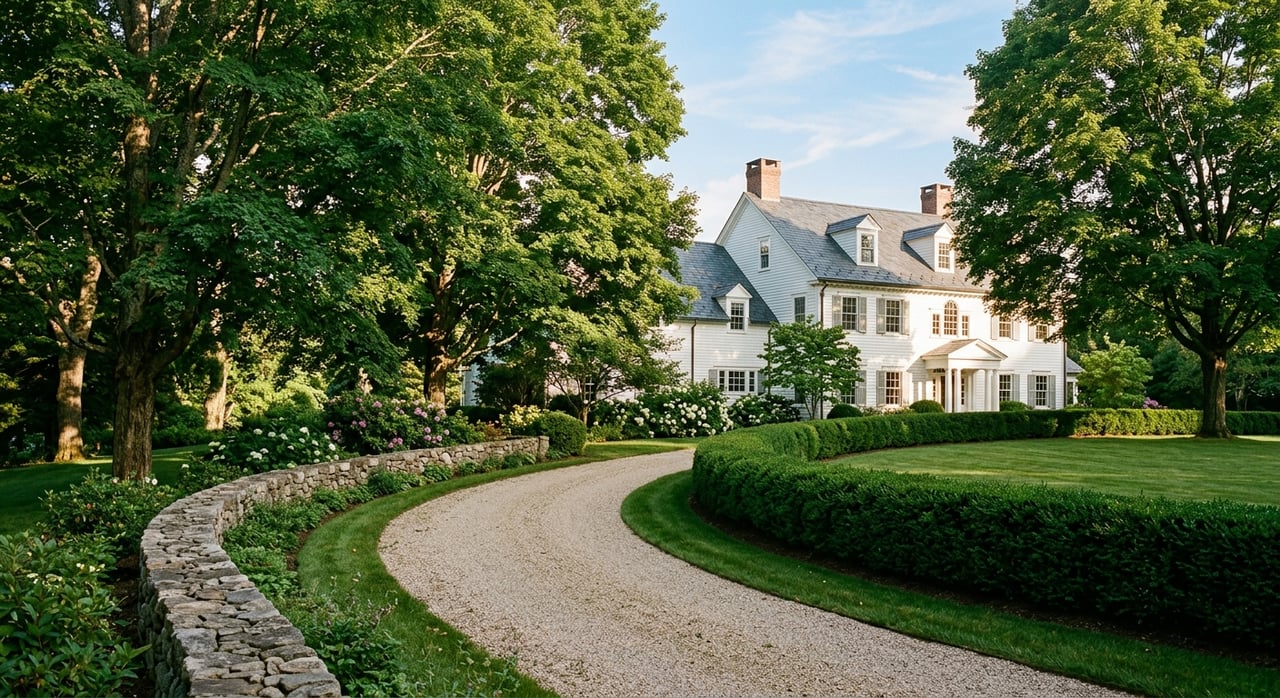
Weston’s physical character also supports a premium on privacy. The Conservation Commission maintains about 1,800 acres of protected land and roughly 90 miles of trails. The town also recognizes native tree buffers as an important way to screen homes from the street, and Scenic Roads protections limit removal of significant trees and stone walls without Planning Board approval.
In practical terms, buyers are often evaluating more than square footage or bedroom count. A home set back from the road, framed by mature trees, or positioned near protected land may feel meaningfully different from another property with similar interior stats. In a high-end market, that difference can show up in price.
Acreage alone is not enough
A common mistake is assuming that more land always means more value. In Weston, that is not always true. Because large lots are the norm, the better question is whether the land is private, functional, and visually attractive.
Features that tend to matter include wooded edges, pond frontage, view corridors, cul-de-sac settings, private roads, and a stronger sense of separation from the street. If you are pricing a home or comparing options as a buyer, these site characteristics often matter more than simply counting acres.
Architecture can outweigh square footage
Weston has a distinct housing mix
Weston’s history helps explain why homes here can vary so much in value. The town points to a wide architectural range, including Colonial, Federal, Shingle Style, Tudor, and Colonial Revival homes. It also notes a major estate-building era around 1900, when affluent Boston residents developed country estates in town.
That legacy still shapes buyer demand today. In Weston, architecture is often part of the value story, not just a style preference. The quality of design, the fit between house and lot, and the overall presence of the home can all influence how a property is perceived in the market.
Price per foot only tells part of the story
Recent sales make that point clearly. One property at 55 Hillcrest Road sold for $3.38 million at about $300 per square foot on nearly 2 acres. Another at 183 Kings Grant Road sold for $2.575 million at about $527 per square foot on just over 2 acres. At 2 Candleberry Lane, the sale was $3.18 million at about $639 per square foot on 1.34 acres, while 8 Hidden Road sold for $9.4855 million at about $875 per square foot on 1.64 acres.
Those numbers show why Weston cannot be reduced to a simple formula. More square footage or more land does not automatically produce the highest value. Architecture, finish level, privacy, setting, and perceived quality can shift pricing dramatically.
Preservation rules matter for luxury homes
Historic context can affect flexibility
Weston’s historic housing stock is part of what gives the town its character. It also has a real regulatory framework around preservation. The town includes one Local Historic District, 10 National Register districts, 26 Historic Areas, and seven individually listed properties.
Pre-1945 buildings on Weston’s Cultural Resources Inventory are also subject to the Demolition Delay By-law. The Historical Commission serves as the town’s preservation body and provides restoration guidance to homeowners. For buyers and sellers, that means an older home may carry both prestige and additional review considerations.
Historic homes are not automatically harder sells
A historic or older property is not necessarily a disadvantage. In many cases, period architecture and estate-era character are part of the premium buyers are seeking in Weston. But if a future renovation, teardown, or major alteration is part of your plan, timing and flexibility may be different from what you would expect in a less regulated market.
That distinction matters during both pricing and due diligence. Sellers benefit from understanding how a home’s historic status may shape buyer interest, while buyers should evaluate not just what the home is today, but what may be possible later.
Renovation and approvals affect value
Major work can trigger review
In Weston, a renovation decision is not just about design or budget. The town’s site plan rules can bring larger projects under formal review. Houses over 3,500 square feet that cover more than 10% of the lot area require Site Plan Approval, and houses over 6,000 square feet require it regardless of lot size.
These rules can also apply to new construction and to some additions or renovations when more than 50% of the existing house is demolished or 75% of the roof is removed. Homes on Scenic Roads also require site plan review. In a luxury market, that means future expansion potential is part of the valuation conversation.
Entitlement clarity reduces friction
For sellers, this is a major pricing point. A home with clean permits, thoughtful landscaping, and a straightforward path for future work can be easier to position and easier for buyers to underwrite mentally. In a market with limited inventory, less uncertainty often supports stronger buyer confidence.
For buyers, it means you should look past the current finishes. A beautiful house with complex approval hurdles may carry a different long-term value than a similar property with cleaner options for future changes. In Weston, entitlement clarity can be as important as cosmetic appeal.
Lot shape and layout also matter
Weston’s zoning rules do more than set minimum lot size. The bylaw also says new building lots cannot be substantially irregular and must be able to contain a quadrangle that meets frontage and area requirements. That can limit subdivision potential and make lot geometry an important part of value.
This is easy to miss if you are only focused on acreage or tax card details. Two lots of similar size may not offer the same flexibility. In higher-end pricing, these differences can influence both current marketability and future upside.
What this means if you are buying
If you are shopping in Weston, broad averages will only get you so far. You need to compare properties based on site quality, privacy, architecture, approval risk, and long-term flexibility, not just list price or square footage.
A smart buying approach usually includes:
- Looking closely at how the home sits on the lot
- Evaluating privacy from the road and neighboring properties
- Understanding whether historic or preservation issues may affect future plans
- Reviewing whether additions or redevelopment could trigger site plan approval
- Comparing value based on overall setting, not acreage alone
In a thin luxury market, details can move pricing fast. A disciplined review process helps you avoid overpaying for the wrong kind of square footage.
What this means if you are selling
If you own a luxury home in Weston, presentation and pricing should reflect what buyers are actually paying for. That often includes landscape quality, screening, architectural character, lot usability, and the clarity of any future improvement path.
It also means pricing cannot rely on simple averages. Two homes with similar size may not compete the same way if one offers better privacy, stronger design, or fewer approval questions. In Weston, strategic positioning matters because buyers tend to notice what is hard to replicate.
This is where strong process control matters. In a market with fewer listings and meaningful property-by-property differences, accurate pricing and clean preparation can shape both time on market and final outcome.
If you are thinking about buying or selling in Weston, Henry Rowe brings a direct, data-driven approach to pricing, positioning, and transaction management so you can move with clarity.
FAQs
What drives luxury home value in Weston, MA?
- The biggest value drivers are often site quality, privacy, architecture, usable land, finish level, and how easily the property supports future work under Weston’s local rules.
Does more acreage always mean a higher price in Weston?
- No. Because Weston already has large-lot zoning, buyers often place more value on privacy, layout, and usability than on lot size alone.
Do historic homes in Weston sell for less?
- Not necessarily. Historic character can support value, but some older homes may involve added review or timing considerations under local preservation rules.
Why can two similar-size Weston homes have very different prices?
- Square footage is only one factor. Architecture, setting, privacy, land quality, and perceived overall quality can create major pricing differences.
Do renovations in Weston always add value?
- Usually not dollar for dollar. Larger projects may involve site plan approval or other review requirements, which can affect cost, timing, and buyer perception.
What should Weston sellers prepare before listing a luxury home?
- Sellers should understand their property’s zoning and approval context, organize permit history, assess landscaping and site presentation, and price the home based on its specific strengths rather than broad averages.